Moutai: From Government Banquets to Business Dinners to the Family Table
Moutai was once the “political correctness” of state banquets; today it slips quietly into family dinners, weddings and gatherings of friends. One bottle of liquor, three chapters of a life: from government liquor to business liquor to family liquor. Moutai’s thirty-year transformation was not a simple change of channels but a self-evolution forced by the macroeconomic cycle — from “a scarce resource for institutions” to “genuine consumption by individuals,” from “selling liquor” to “selling a way of life.”
According to Kweichow Moutai’s own historical records and a review of its financial reports, government procurement once accounted for nearly 50% of sales. After the Eight-Point Regulation at the end of 2012, the company put forward “three transformations and five shifts,” and business settings rose fast. From 2021, with the property cycle at a trough and consumption weak, Moutai accelerated its push toward the consumer. iMoutai launched in 2022, and the direct-sales share climbed quickly from its low in 2018; the company explicitly committed to being “consumer-centered and market-oriented,” focusing on three transformations — customer base, settings, service — and rolling out a coordinated model of “direct sale + distribution + agency sale + consignment,” pushing channels further down into household and private consumption.
I. The era of government liquor: the national drink’s “political endorsement” (1950s–2012)
In 1951 local government merged three private distilleries into the Moutai distillery, and Zhou Enlai made it the liquor of state banquets. When Nixon visited in 1972, Moutai became a diplomatic gift; for National Day and military parades it was flown in for the occasion. Early sales ran mainly through state-run sugar-and-liquor companies and group purchasing; government and state-owned-enterprise purchases accounted for nearly 50%, and the wholesale price climbed with high economic growth, exceeding 2,000 yuan before 2012.
In those years what Moutai poured was not only liquor but status. The brand premium came from a “political halo”: scarcity plus endorsement, and terminal demand that could not be met. Company filings and historical reporting both show sales growing at 44% in this period, entirely dependent on institutional, government settings.
II. The anti-corruption shock and the forced rise of business liquor (2013–2021)
The Eight-Point Regulation at the end of 2012 landed like a storm. Spending on the “three public expenditures” collapsed, and Moutai took a direct hit. In 2013–2014 the share price halved from its high (a drop of about 50%), the wholesale price fell from above 1,200 yuan to a low of roughly 830, and sales growth collapsed from 44% to 2%. For the first time the company’s annual report admitted to “unprecedented pressure.”
Crisis forced the transformation. From 2013 Moutai advanced “three transformations and five shifts”: from government settings to high-end business ones — corporate banquets and gifts. Distributors expanded rapidly and restaurant accounts became the main channel; after 2015 the company stopped adding distributors at scale and turned to e-commerce and to pushing its series liquors down-market. Business settings replaced government ones as the main source of growth.
After 2018 the share price reclaimed its throne as “king of stocks.” The record shows that business liquor taught Moutai to survive by the market: from an iron rice bowl to a market rice bowl. Channel profits were squeezed, but a far broader institutional space opened up.
III. The metamorphosis into family liquor: breaking through to consumers in the property slump (2022 to today)
From 2021 Chinese property entered a downcycle, high-end consumption weakened, and Moutai’s wholesale price came under pressure. In the first three quarters of 2025 revenue grew only 6.32%, and the full-year target was cut to single digits for the first time. In March 2026 the wholesale price of Feitian briefly fell below 1,600 yuan, a multi-year low.
The company moved decisively to go “one step to the consumer.” iMoutai launched in March 2022, and direct-sales revenue jumped 105.4% that year. In 2024 direct-channel revenue reached RMB 74.843 billion, or 43.87% of the total, at a gross margin of 95.33% (far above the 89.42% of wholesale agency); iMoutai alone took in RMB 20.024 billion for the year. In the first half of 2025 the direct share held steady at around 44.8%.
Moutai then upgraded its strategy across the board, issuing a market-based operating plan and applying an “agency sale” model to personalized products (aged Moutai, premium Moutai, zodiac bottles, Guyue Feitian, small-format Feitian and others), formally establishing the new coordinated structure of “direct sale + distribution + agency sale + consignment.” Under agency sale, title does not transfer and the distributor need not prepay in full — only post a deposit — and reaches consumers through online retail, physical stores, restaurants and private channels, earning a service fee of about 5% (a commission). A 500ml bottle of 53-degree premium Moutai, for example, retails at 2,299 yuan, of which the distributor earns about 115 yuan. Every agency-sale product must be sold through the iMoutai platform; former group-buying clients can scan a store-specific QR code, ordering online and collecting in store, which mainly serves retail customers.
A Moutai executive put it plainly: “We must change of our own accord, serve our channel partners well, and help them shift roles — from the traditional job of moving goods to carrying Moutai’s offline display and service functions, so that company and distributors together serve the consumer.” The move takes back pricing power, steadies prices on non-standard products, and curbs channel speculation, while turning distributors from merchants who sit and wait into merchants who go out — asset-light, service-heavy, and genuinely working the end market.
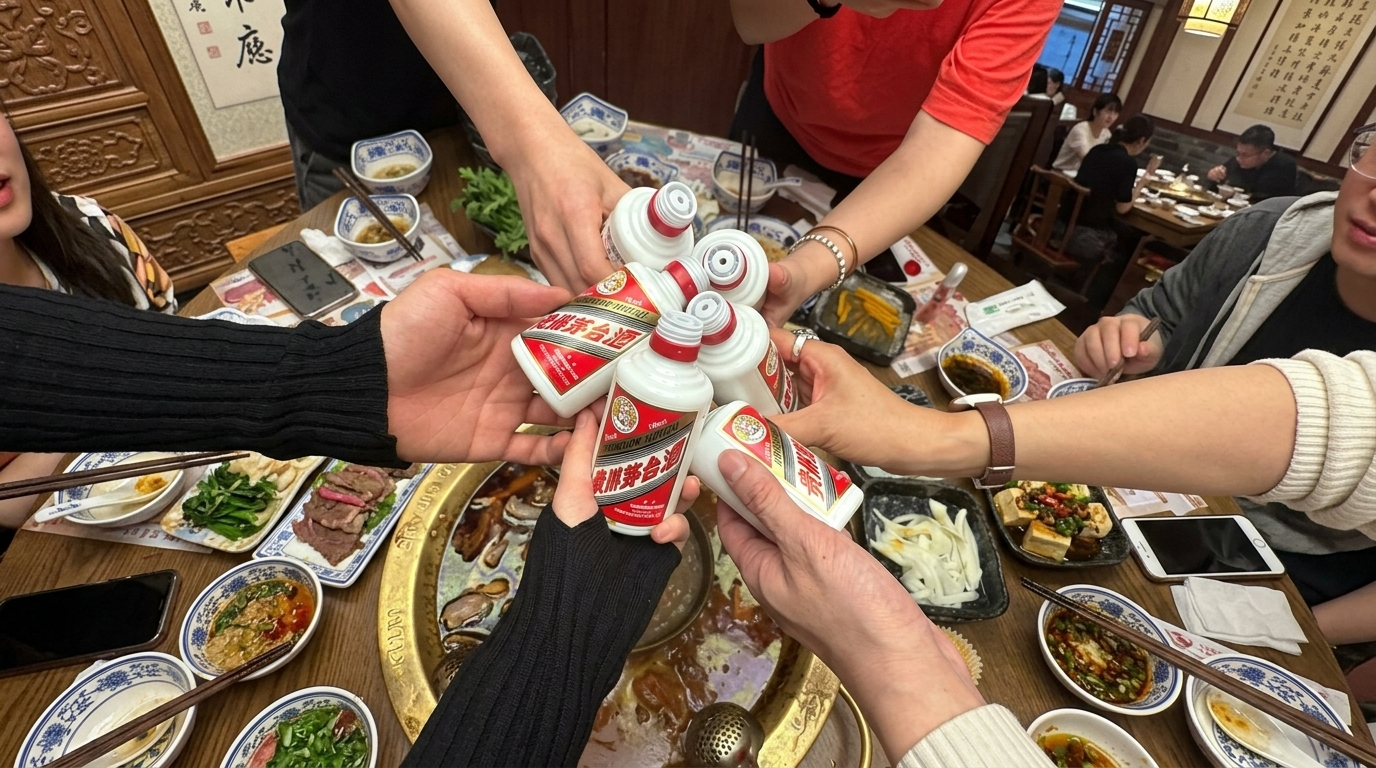
The shift shows most clearly in the settings: from business banquets to family dinners, weddings, birthday banquets and gatherings of friends. Stores have set up “family banquet corners,” the iMoutai share of users keeps rising, and consumers report using Moutai more often at family gatherings. The post-90s and post-85s cohorts are becoming the main force, with buy-and-drink-now and small formats for personal use the emerging pattern. Moutai moves from “the glory of government liquor, the survival of business liquor” to “the homecoming of family liquor” — a glass that keeps real life company.
IV. The logic beneath it, and what it teaches
Moutai’s three transformations are, at bottom, the macro cycle forcing a micro one: anti-corruption weaned it off government dependence, and the property slump catalyzed its awakening to consumers. The company moved from policy dividend to consumer sovereignty, completing a return to commercial logic. The agency-sale model is the latest footnote to that shift — it turns channel profit from speculative to stable and forces distributors to work the consumer end rather than hoard and flip. Analysts note that distributors with real consumer-facing capability and community networks will win more quota, while the old pure goods-flipping model is cleared out as a matter of course.
For the industry this is a template. Baijiu makers must embrace digitalization and scene-building early and compete for younger customers and private consumption. Whether Moutai’s “family liquor” strategy succeeds will turn on the bottle-opening rate and its penetration among younger drinkers. So far execution has been firm: iMoutai is the core consumer lever, and both the wholesale price and the share price are steadying through the transition.
V. Closing
Government liquor was glory, business liquor was survival; family liquor is where it belongs. Moutai’s transformation is not only a corporate story but a mirror of the times — from a symbol of power to a companion of daily life, reflecting the micro-level upgrade of Chinese consumption from institutions to individuals. One hopes for more innovation still, so that the national liquor’s fragrance truly reaches ordinary households.
On your own dinner table, which kind of liquor is Moutai? Comments welcome.