
A Reflection Spanning Twenty Years: Where Is My Math Ceiling?
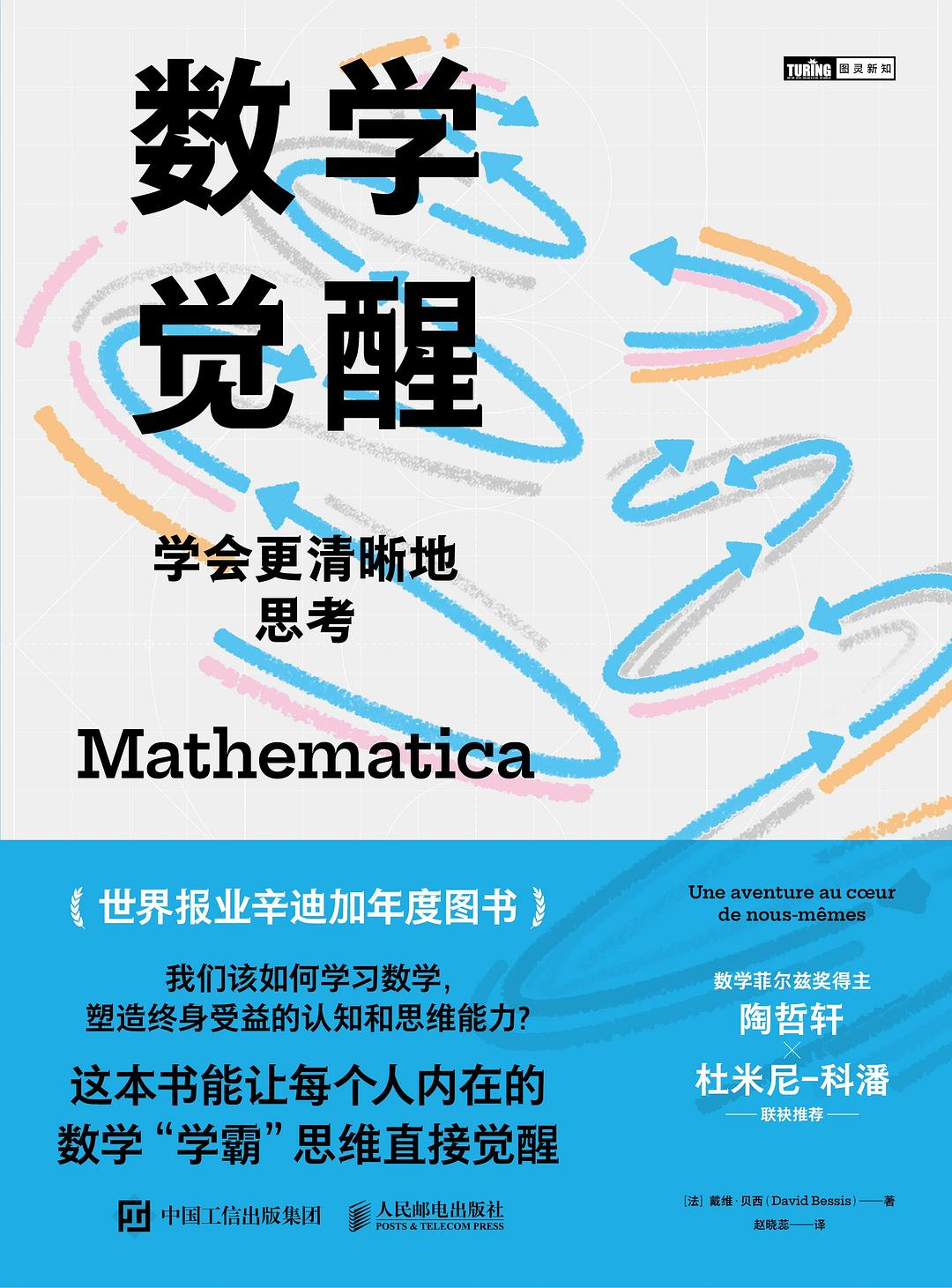
I spent three days, on and off, finishing Mathematics Awakening: Learning to Think More Clearly, and throughout the reading my wife and I argued intensely. By historical grades and by the math ability I still retain, I was a top student and my wife was a poor one, but the two of us could discuss this book passionately, because it isn’t a math book in the ordinary sense. It tries to reveal the mental landscape of a mathematician doing mathematics; it’s closer to a book of psychology or philosophy.
When I finished the book, I put down my phone and said to my wife: I feel a little like crying. But I also saw quite a few negative reviews on WeChat Reading, and I thought: to understand a book, or to resonate strongly with its author, takes a certain alignment of circumstances. If my first forty years were to be described with a few keywords, “mathematics” would have to be one of them. It built my early, powerful self-confidence, and later it also plunged me into deep doubt and self-doubt.
My clear memories of learning — mathematics especially — start in the middle years of primary school. In that era, when the countryside was still very poor and short of everything, supplementary workbooks were not a common thing. But my parents spent money to buy me one in the Xinhua Bookstore in the city, called A Quarter Hour a Day. The math problems in it were especially hard; by today’s standards they’d probably put fairly easy Olympiad problems in there. My parents had no idea how to explain such problems in a way a primary schooler could understand, but they had at least studied a little algebra properly, and so that summer they spent a few afternoons hiding from the heat teaching me to solve those problems with equations. Primary school math back then didn’t teach equations at all (today’s textbooks introduce them earlier, and it’s been proven that primary schoolers don’t find simple equations all that hard).
Suddenly I felt I had a very handy weapon in my hands. Besides finishing that workbook, for the many folk math puzzles my grandfather set me, solving them with equations was like cutting melons and chopping vegetables — trivially easy. Get them right and there was a red envelope, plus praise. Math class was the same. People generally assume that someone good at math, with good math grades, is smart, and that smart people can learn anything — physics, chemistry, or Chinese and English. And so it became a self-fulfilling expectation: I always felt I was ahead of my classmates and even the teachers, so I basically didn’t listen in class — math and science classes especially, I spent them reading on my own, thinking, and doing exercises ahead of the schedule. The results felt like a cheat code all the way: from a national second prize in the primary school math Olympiad, to the first district-wide exam in middle school, where my total score beat the second in the grade by over a hundred points without much effort, to being specially recruited into the city’s No. 1 high school.
In high school math I began to feel the ceiling of my ability. Daily coursework and exams were no problem; I still often got full marks. But when the problems got harder, that effortless cutting-through-melons feeling from primary school equations was gone — high school Olympiad math especially was beyond me. At first this didn’t make me too anxious: in my third-year mock exams my math was still 145-plus, near perfect. My homeroom teacher was a math teacher, and he even told me that given the current gaokao situation, there was no need to spend extra time going deeper into math; better to put more time into Chinese and English, where the return would be higher.
Then came the 2003 gaokao, the one that is mildly famous even in the history of the exam: the math paper was far harder than in previous years. A male classmate of mine, whose math was usually decent, came out of the exam room crying. I wasn’t much better. From the multiple choice and fill-in-the-blank questions onward I felt strong discomfort, and by the first big solid geometry problem I hadn’t even fully solved it — traditionally that question is called a free-points question. I tried every means to steady my frame of mind, even spending time attacking the final bonus problem, but the final result was merely passable: a bit over 110. Fortunately in the later comprehensive science paper, though the questions were also hard, I held my nerve, and my final total was about 5 points short of the Tsinghua/Peking University cutoff. At the time I actually knew nothing about universities; I had simply absorbed from public opinion the claim that Tsinghua and Peking were good schools. Given how I usually performed, I ought to have gotten in. I didn’t, and I naturally interpreted that as a failure. I did end up in the computer science department at USTC, but the shadow of that failure hung over me for many years — so much so that my college life and my earliest career choices now look like a mess.
Only after thirty, after marrying and establishing a career, did I slowly come to terms with these things. The first thing that released me was realizing this was a question of breadth of vision. For me at that time, entering USTC was a resigned choice made after the correct option had been taken away; my limited horizons meant I didn’t know how to begin my college life. Though in a broader sense, getting into USTC was undoubtedly a success — I just couldn’t feel that success at the time, and no one could make me truly understand that university study is inherently far harder than high school. I remember stepping onto the USTC campus and seeing seniors at stalls outside the cafeteria selling books, many of them TOEFL and GRE vocabulary books. At the time I was baffled and repelled by the sight, not realizing that those people aiming to go abroad — whether or not their choice was right — at least had a plan, had a choice.
Then I thought: breadth of vision doesn’t seem to explain everything either. There are also kids from the countryside who, once in university, take to it like fish to water and quickly reach heights beyond mine. So is all of this, then, about intelligence? Was my intelligence insufficient to support my university studies, so that my college math was only half-understood — the exam scores were fine, but I never fully grasped it — so that years later, when I was studying artificial neural networks, I always felt I’d missed too many classes in mathematics? But setting aside how hollow the concept of IQ is, it can’t even explain this: if I got into USTC by underperforming, why did so many of my classmates, who entered USTC with similar scores, live fuller college lives than I did and develop better after graduation? You can’t very well say they were smarter than me all along and simply underperformed by a wider margin.
Finally I came to suspect confidence and courage — that the gaokao had damaged my confidence and courage, producing some subtle sense of defeat, and that this was what made my college life muddled along. But this is a hidden psychological experience not fit to be told to outsiders; I had only ever discussed it with my family. Having dissected myself this far, I can return to Mathematics Awakening: Learning to Think More Clearly and explain why it moved me so much. The book comes from a French mathematician, who analyzes the mental landscape of his own mathematical research and that of Einstein, Descartes, and a whole company of first-rate mathematicians and scientists. It let me finally let go and make peace with myself.
The author, an established mathematician, bravely admits that he finds it almost impossible to read any professional mathematics book written by a mathematician, and cannot follow the thesis defense of a math PhD student. Einstein told a middle schooler that the mathematical difficulties he faced were no fewer than the student’s — these are not modesty or politeness but honest statements. Mathematicians, like ordinary people, face enormous difficulty before mathematics. So why is the gap in mathematical ability between people so vast? Su Bingtian’s 100 meters is 9.83 seconds; an ordinary able-bodied person cannot beat Su Bingtian, but at worst they can finish in 20 or 30 seconds. In mathematics, though, the gap between people seems to be that some need an hour to cover 100 meters.
Mathematics is about imagining and manipulating abstract objects, and that is a capacity everyone is born with. But this imagining and manipulating of abstract objects in the mind, unlike language and movement, is hard to learn by imitation, and so many people give it up early and define themselves as having no talent for it. Logical reasoning is only one expressive language of mathematics, a finger pointing at the moon, not the whole truth of mathematics. Mathematics is first about curiosity and imagination, and ultimately about intuition; sooner or later all of these hit a “ceiling.” The people who break through that ceiling again and again are called mathematicians. It isn’t about IQ here; it’s about courage and confidence. In the face of abstract concepts, a vast sense of ignorance easily knocks a person down — but when you know that the ignorance faced by the greatest mathematicians is equally daunting, and then look at the heights they reached, at least some courage rises in you unbidden. Aim high and you will land in the middle; of course few can become mathematicians as great as Descartes, but it is certain that in mathematics the vast majority of people — myself included — vastly underestimate themselves.
Only by believing can something exist and be realized. Mathematics, in a sense, is a self-fulfilling expectation. Isn’t life the same?